














10
Marble and Granite Difference: Find the Best for Your Home
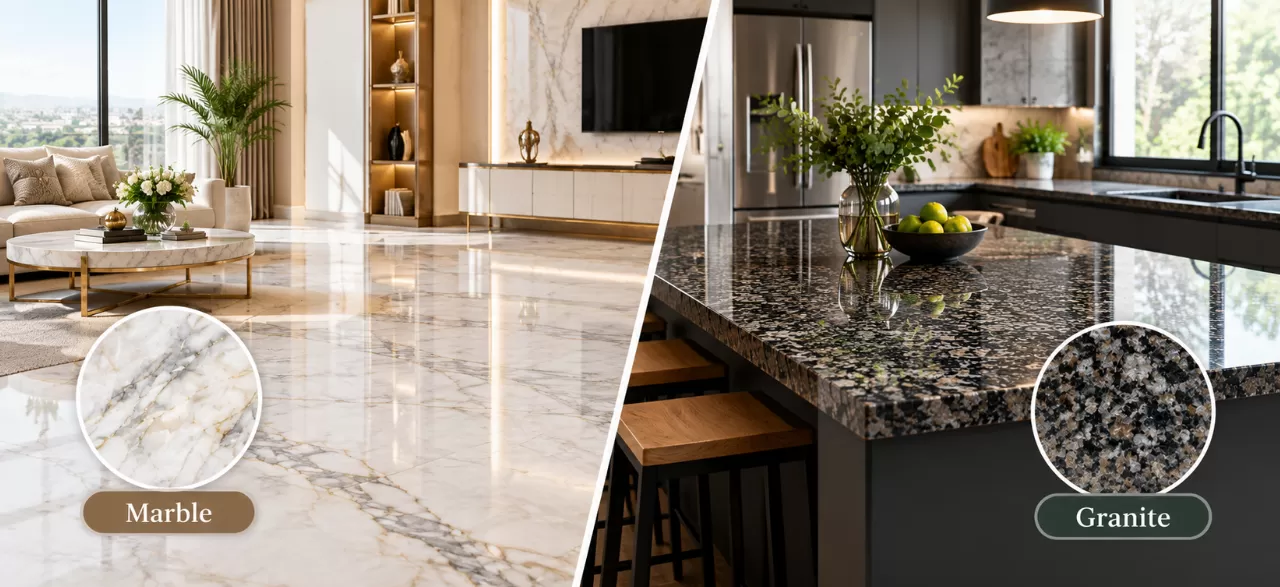
The main marble and granite difference lies in their formation, hardness, appearance and maintenance requirements. Marble is a metamorphic stone known for its elegant veins and timeless appeal, while granite is an igneous stone that is generally harder and more resistant to everyday scratches. Both natural stones can enhance residential interiors, but the right choice depends on where you plan to use them and how you want your home to look.
When comparing marble vs. granite, consider durability, appearance, cleaning requirements and total installation costs. Marble is often preferred for sophisticated flooring, feature walls and decorative spaces, whereas granite is a practical option for busy flooring areas and many kitchen countertops.
This guide explains the difference between marble and granite, compares their costs and performance, and helps you decide which material best suits your home’s needs.
What Is the Difference Between Marble and Granite?
The primary difference between marble and granite is their geological formation and mineral composition. Marble forms when limestone undergoes heat and pressure, while granite develops when molten material cools slowly beneath the Earth’s surface.
Marble mainly contains calcite, which contributes to its characteristic veining and sensitivity to acids. Granite primarily contains quartz and feldspar, making it generally harder and more resistant to everyday wear.
| Feature | Marble | Granite |
|---|---|---|
| Rock type | Metamorphic | Igneous |
| Main minerals | Primarily calcite | Mainly quartz and feldspar |
| Appearance | Flowing veins and soft patterns | Speckled or granular patterns |
| Hardness | Generally softer | Generally harder |
| Scratch resistance | Relatively lower | Generally higher |
| Acid sensitivity | High | Generally lower |
| Maintenance | Requires careful cleaning | Usually easier to maintain |
| Common uses | Flooring, walls and decorative interiors | Flooring, countertops and entrances |
Understanding these differences helps you choose a stone based on your design preferences, budget and intended application. If you are planning your flooring design, explore our guide on which colour is best for floor tiles to find colour options that complement your home’s interiors.
Marble vs Granite: Which Is More Durable?
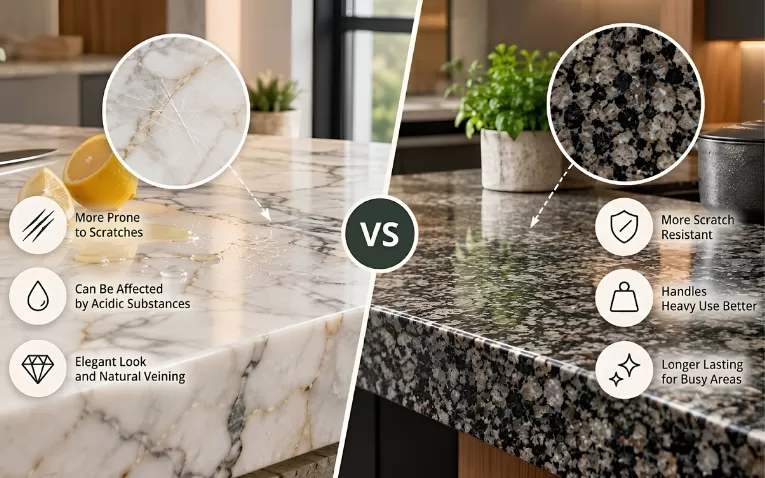
Granite is generally more durable than marble when scratch resistance and heavy daily use are the main priorities. Its mineral composition makes it harder than most marble varieties, while marble is more susceptible to scratching and acid etching.
The Mohs hardness scale helps explain this difference. Calcite, the primary mineral in most marble, has a hardness of approximately 3, while quartz has a hardness of 7. These figures describe individual minerals rather than the overall performance of every stone slab.
Marble can still provide long-lasting performance in residential spaces when properly installed and maintained. However, abrasive dirt, dropped objects and unsuitable cleaning products can damage its finish.
If you are comparing flooring materials for your home, explore our tiles vs marble vs granite guide to understand the differences in durability, maintenance, appearance and suitability for different spaces.
Which should you choose? Granite is generally preferable for busy areas that experience frequent use. Marble is an excellent choice when elegant veining and a refined appearance are your main priorities.
Which Stone Handles Daily Use Better?
The best material depends on the location, foot traffic and activities taking place on the surface. Both marble stone and granite stone offer distinct benefits, making them suitable for different areas of a home.
Granite stone is often suitable for entrances, staircases, high-traffic flooring areas and kitchen countertops because of its hardness and generally better resistance to everyday scratching. However, its performance also depends on the specific variety, surface finish, sealing and maintenance.
Marble stone is popular for living rooms, bedrooms, hallways and decorative interiors where its natural veining and elegant appearance can become a design highlight. It is particularly suitable for homeowners seeking a luxurious, timeless finish, but it requires additional care around acidic liquids and abrasive materials.
Before choosing marble stone or granite stone, consider the expected foot traffic, surface finish, installation quality and supplier’s maintenance recommendations. Comparing these factors helps you select the right natural stone for your home’s design and long-term performance.
Granite Flooring vs. Marble Flooring
When comparing granite flooring vs. marble flooring, both materials offer a premium appearance but create different visual effects and maintenance requirements.
| Factor | Marble Flooring | Granite Flooring |
|---|---|---|
| Visual appeal | Elegant veins and refined patterns | Granular textures and varied colours |
| Durability | Good with proper care | Generally better scratch resistance |
| Maintenance | Requires careful cleaning | Usually moderate maintenance |
| Acid sensitivity | More sensitive | Generally less sensitive |
| Design suitability | Luxury and classic interiors | Contemporary and traditional interiors |
| Common applications | Living rooms, bedrooms and feature spaces | Entrances, busy areas and selected kitchens |
Marble flooring works well for homeowners who prefer distinctive veins, sophisticated interiors and a luxurious finish. To explore another popular flooring option, compare marble vs tiles for flooring to understand the differences in appearance, maintenance, durability and overall cost. This comparison can help you choose a flooring material that suits your home’s design and everyday needs.
Granite flooring is suitable for areas where durability and resistance to everyday wear are important. Its varied colours and granular patterns can complement both modern and traditional interior designs. For a broader overview, explore this comparison of tiles, marble and granite to evaluate the key differences in appearance, durability, maintenance and cost.
When comparing the two, inspect actual samples under your home’s lighting. Also consider slip resistance, particularly in entrances, bathrooms and other areas that may become wet. A polished surface is not automatically the safest option for every location.
Which Looks Better: Marble or Granite for Home Interiors?
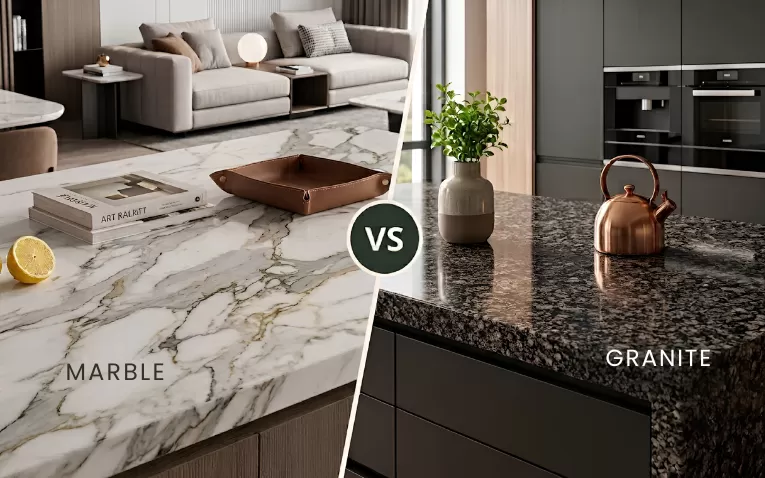
When comparing marble and granite, the main differences are their appearance, natural patterns, durability and maintenance requirements. Marble offers elegant veining and a luxurious finish, while granite features granular patterns, varied colours and generally better scratch resistance. The best choice depends on your interior style, budget and intended use.
Marble for elegant interiors: Marble is popular for its flowing veins, soft colour variations and timeless appeal. White marble with grey veins creates a bright, sophisticated look, while beige and cream marble complement warm, neutral interiors. It works particularly well in living rooms, bedrooms, feature walls and classic interior designs.
Granite for durability and varied designs: Granite typically features speckled patterns, visible mineral grains and a broad range of colours. Its harder surface generally offers better resistance to everyday scratches, making it suitable for flooring, entrances and other frequently used areas.
Before choosing either material, compare the actual slabs, surface finish and maintenance requirements. Natural stone patterns vary, so inspecting the material helps ensure it complements your interior design.
Which is better for your home? Choose marble if you prefer refined veining and a premium, classic appearance. Consider granite if you want distinctive natural patterns, generally better scratch resistance and a surface that is often easier to maintain.
What Is the Cost Difference Between Marble and Granite?
The cost of marble and granite varies according to the variety, quality, origin and installation requirements. Neither material is always cheaper than the other, so comparing specific options provides a more reliable estimate.
If you are also considering tiles for your project, check the cost of tiling per square foot in India to understand tile pricing and estimate your flooring budget, including installation expenses.
The total project cost depends on several factors:
- Stone variety, grade and origin
- Slab thickness and dimensions
- Surface finish and processing
- Availability and transportation
- Cutting, wastage and installation
- Sealing and long-term maintenance
Imported marble, rare granite varieties and premium finishes may cost more than readily available alternatives. Installation expenses can also increase when the project involves intricate cutting, stairs, unusual dimensions or complex layouts.
For an accurate comparison, request quotations for the actual stones you are considering. Compare the material price per square foot alongside installation, cutting, wastage and finishing costs. This gives you a clearer understanding of the overall budget rather than relying on material prices alone.
Granite or Marble: Which Is Better for Your Home?
The answer to granite or marble which is better depends on your priorities, the installation location and the amount of maintenance you are comfortable managing.
Choose granite if you prioritise hardness, scratch resistance and practical performance in frequently used areas. It is often a suitable choice for entrances, busy flooring areas and kitchen countertops, provided the specific variety and finish meet your requirements.
Choose marble if you prefer elegant veining, distinctive natural patterns and a classic appearance. It is often selected for living rooms, bedrooms, feature walls and decorative flooring where aesthetics are especially important.
Before making your decision, compare samples, check maintenance requirements and calculate the total installed cost. The best material is the one that balances your design preferences, everyday functionality and budget.
Conclusion
Understanding the marble and granite difference helps you choose the right material for your home’s flooring, kitchen and interior spaces. Marble offers elegant veining and timeless appeal, while granite generally provides greater hardness and better resistance to everyday scratches. The best choice depends on your design preferences, usage requirements, maintenance needs and budget.
Which is better, marble or granite? Choose granite for frequently used areas where durability and scratch resistance matter most. Choose marble for living rooms, bedrooms and decorative spaces where natural patterns and a luxurious finish are priorities.
As a trusted tile company, Spenza Ceramics offers a wide range of tile designs for residential and commercial interiors. Explore our collection to compare colours, patterns, sizes and finishes that complement your preferred style. Whether you are planning a modern home or a classic interior, discover suitable tile solutions with Spenza Ceramics, a tile company focused on combining design, quality and functionality.
Related Blogs

Vastu for Home: 15 Simple Tips for a Positive Space
Read Now →
Normal Village House Design: 15 Simple Ideas
Read Now →
What Are the Best Interior Tile Colours for Modern Homes in 2026?
Read Now →
What Are the Best Ground Floor House Design Ideas for Indian Homes?
Read Now →Marble vs Granite: Which Is Best for Your Home?
Still deciding? Explore stylish tile alternatives with Spenza Ceramics and find the perfect flooring for your space.
Contact UsMarble vs Granite FAQs: Cost, Durability and Best Uses
Understand the marble and granite difference, including durability, flooring, maintenance, kitchen countertops and cost to choose the right stone for your home..
Vastu for Home: 15 Simple Tips for a Positive Space
Vastu for home is a traditional Indian approach to planning a house according to directions,....
Normal Village House Design: 15 Simple Ideas
A normal village house design focuses on comfortable living, practical space planning, natural light, proper....
What Are the Best Interior Tile Colours for Modern Homes in 2026?
Choosing the right interior tile colours can completely change how a modern home looks and....