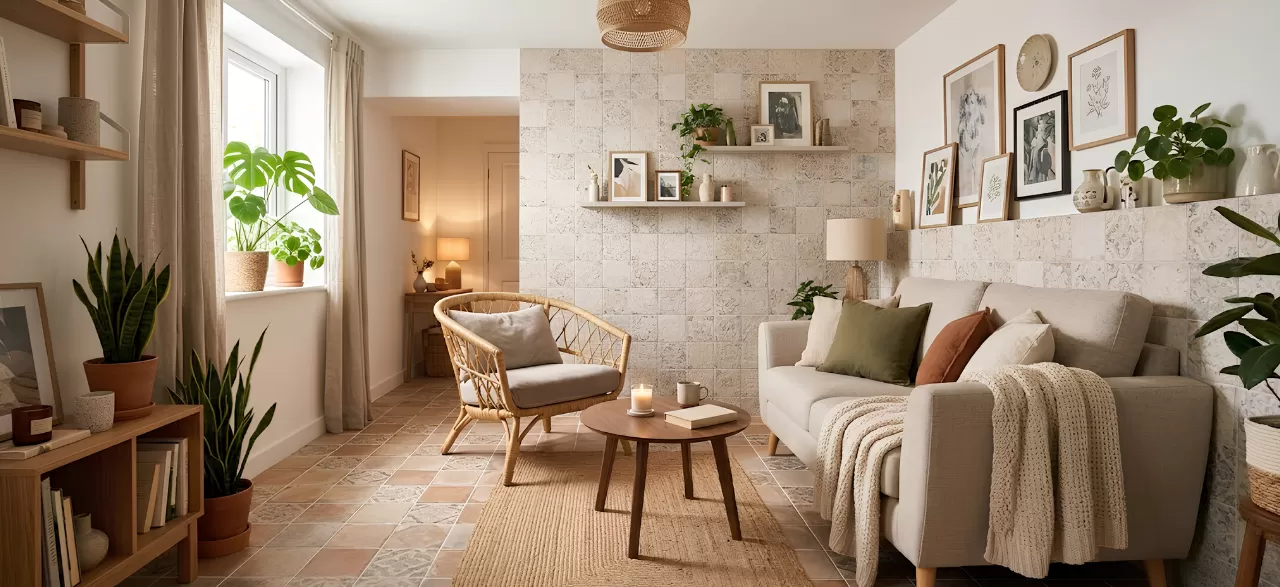
Calculate how many tiles you need for your floor or wall project.
We recommend adding 10% wastage for cutting, breakage and future replacement.
Planning a flooring or wall tiling project? Use the Spenza Ceramics Tile Calculator to estimate the number of tiles required for your space quickly and accurately. Enter your area dimensions, choose the tile size, and account for wastage to get a practical estimate before ordering tiles.
Whether you are calculating tiles for a living room, bedroom, kitchen, bathroom, balcony, terrace, or wall, knowing the required tile quantity helps you plan your material, reduce unnecessary waste, and avoid running short during installation.
A tile calculator determines the number of tiles required by comparing the total area of your floor or wall with the coverage provided by one tile.
The basic calculation is:
For a more realistic estimate, add an allowance for cutting and breakage:
The final quantity should be rounded up to the next whole tile or complete box, depending on how the tiles are sold.
Calculating tile quantity manually is simple when you follow these steps.
Measure the length and width of the floor or wall you want to cover.
For a rectangular floor:
Area = Length × Width
For example, if a room is 12 feet long and 10 feet wide:
12 × 10 = 120 sq. ft.
So, the total area to be tiled is 120 square feet.
Find the dimensions of the tile you plan to use.
For tiles measured in inches:
Tile Area in sq. ft. = Tile Length × Tile Width ÷ 144
For example, a 24 × 24 inch tile covers:
24 × 24 ÷ 144 = 4 sq. ft.
So, one 24 × 24 inch tile covers approximately 4 square feet.
If your room is 120 sq. ft. and each tile covers 4 sq. ft.:
120 ÷ 4 = 30 tiles
You need 30 tiles before allowing for cutting and breakage.
Tiles may need to be cut around corners, doors, pillars, drains, furniture or other fixed areas. Some tiles can also break during transportation or installation.
For a straightforward layout, a 5–10% allowance is commonly used. More may be required for diagonal, herringbone, intricate layouts or spaces with many cuts.
For the 120 sq. ft. example with 10% wastage:
30 × 1.10 = 33 tiles
Therefore, you should plan for approximately 33 tiles.
Suppose you want to tile a 12 ft × 10 ft room using 24 × 24 inch tiles.
| Calculation | Result |
|---|---|
| Room length | 12 ft |
| Room width | 10 ft |
| Total area | 120 sq. ft. |
| Tile size | 24 × 24 inches |
| Area per tile | 4 sq. ft. |
| Tiles before wastage | 30 |
| 10% wastage | 3 tiles |
| Estimated requirement | 33 tiles |
Always check the tile coverage mentioned on the product carton before placing the final order because the number of pieces per box and coverage can vary by tile size and product.
Wall tile calculation is slightly different because you normally need to consider both the width and height of the wall.
For a rectangular wall:
Wall Area = Wall Width × Wall Height
For example, a wall measuring 12 ft wide and 8 ft high has:
12 × 8 = 96 sq. ft.
If there is a window, door or other area that will not be tiled, calculate its area and subtract it from the total wall area.
Net Wall Area = Total Wall Area − Non-Tiled Area
For multiple walls, calculate each wall separately and add the areas together.
If you are tiling several walls, do not simply multiply one wall measurement unless all walls are identical.
Measure each wall individually:
Wall 1 Area + Wall 2 Area + Wall 3 Area + Wall 4 Area = Total Wall Area
Then subtract doors, windows or other areas that will remain uncovered.
This method is particularly useful when calculating tiles for bathrooms, kitchens and feature walls where wall dimensions can vary.
Wastage is an important part of tile calculation because tiles rarely fit an entire space without cuts.
The amount of extra tile depends on the size and shape of the area and the installation pattern.
| Project Condition | Suggested Allowance |
|---|---|
| Simple rectangular room, straight layout | 5–10% |
| Rooms with several corners or cut-outs | 10% |
| Diagonal or more complex layouts | 10–15% |
| Herringbone or intricate patterns | 15% or more |
| Irregular outdoor areas | 10–15% |
These are planning guidelines rather than fixed rules. Your installer may recommend a different allowance based on the tile size, layout and complexity of the installation.
Ordering exactly the calculated quantity can create problems if tiles are damaged or additional cutting is required.
Keeping some extra tiles can help with:
For future repairs, keeping spare tiles from the original batch can be especially useful because the appearance of a later production batch may differ slightly.
Tiles are often sold by the box rather than individually. Once you know the required tile quantity, check how many pieces are included in one box.
For example:
Tiles required = 33
Tiles per box = 4
33 ÷ 4 = 8.25
Since you cannot purchase a fraction of a box, round up:
9 boxes required
Always verify the actual pieces per box and square-foot coverage printed on the product packaging before ordering.
You can estimate your tile material cost after calculating the required area or quantity.
If the tile is priced per square foot:
Tile Cost = Required Tile Area × Price per Sq. Ft.
For example, if you need 132 sq. ft. including wastage and the tile costs ₹80 per sq. ft.:
132 × ₹80 = ₹10,560
If the product is priced per box:
Tile Cost = Number of Boxes × Price per Box
Remember that the overall tiling budget may also include installation labour, adhesive, grout, trims, skirting, surface preparation and other installation materials.
A tile calculator can be used for almost any regular tiling project.
For living room flooring, measure the complete floor area and select the tile size you intend to install. Larger tiles can reduce the number of visible joints, but the room layout and cutting requirements should also be considered.
Measure the length and width of the bedroom to calculate the floor area. Add an appropriate wastage allowance before deciding the final quantity.
Kitchen calculations may require separate measurements for the floor, backsplash and walls. Cabinets, platforms, windows and other areas that will not receive tiles should be excluded from the calculation.
Bathrooms often involve several walls, corners, niches and plumbing cut-outs. Measure each surface separately and allow additional material for cuts.
For balconies and terraces, measure the complete usable tiling area and account for edges, corners and drainage-related cuts. The tile itself should also be suitable for the intended outdoor application.
Not every room is a perfect rectangle. If your space has an L-shape or multiple sections, divide it into smaller rectangles.
Calculate each section separately:
Section A Area + Section B Area + Section C Area = Total Area
Then calculate the tile requirement for the combined area and add the appropriate wastage allowance.
This approach is generally easier and more reliable than trying to calculate an irregular room as one shape.
Yes. Tile size directly affects the number of individual tiles needed to cover an area.
For example, a 12 × 12 inch tile covers approximately 1 sq. ft., while a 24 × 24 inch tile covers approximately 4 sq. ft.
Therefore, the same 100 sq. ft. area requires many more individual 12 × 12 inch tiles than 24 × 24 inch tiles.
However, larger tiles can require more careful handling and may result in additional cutting in small or irregular spaces. The best tile size should therefore be selected based on the room dimensions, layout, design and installation requirements.
Grout is the material used to fill the joints between tiles. The width of the grout joint can affect the finished layout and the overall material requirement, particularly with smaller tiles and wider joints.
The actual grout requirement should be calculated separately based on tile dimensions, joint width, tile thickness and the product manufacturer’s coverage information.
For tile quantity planning, follow the tile manufacturer’s recommended installation joint and your installer’s guidance.
The Spenza Ceramics Tile Calculator makes tile quantity planning easier by helping you estimate the material required before starting your project.
It can help you:
Instead of relying only on manual calculations, use the calculator first and then verify the final quantity with your tile installer or dealer.
Before placing your tile order, keep these points in mind:
For a rectangular floor:
Area = Length × Width
For a wall:
Area = Width × Height
For tile coverage:
Tile Area = Tile Length × Tile Width ÷ 144
(when tile dimensions are in inches)
For tile quantity:
Tiles Required = Total Area ÷ Tile Area
With wastage:
Final Tile Quantity = (Total Area ÷ Tile Area) × (1 + Wastage %)
Always round the final quantity up to a whole number and check the product’s box coverage before ordering.